Blog

  • What “quantum-safe certificate methodology” actually means

    What “quantum-safe certificate methodology” actually means

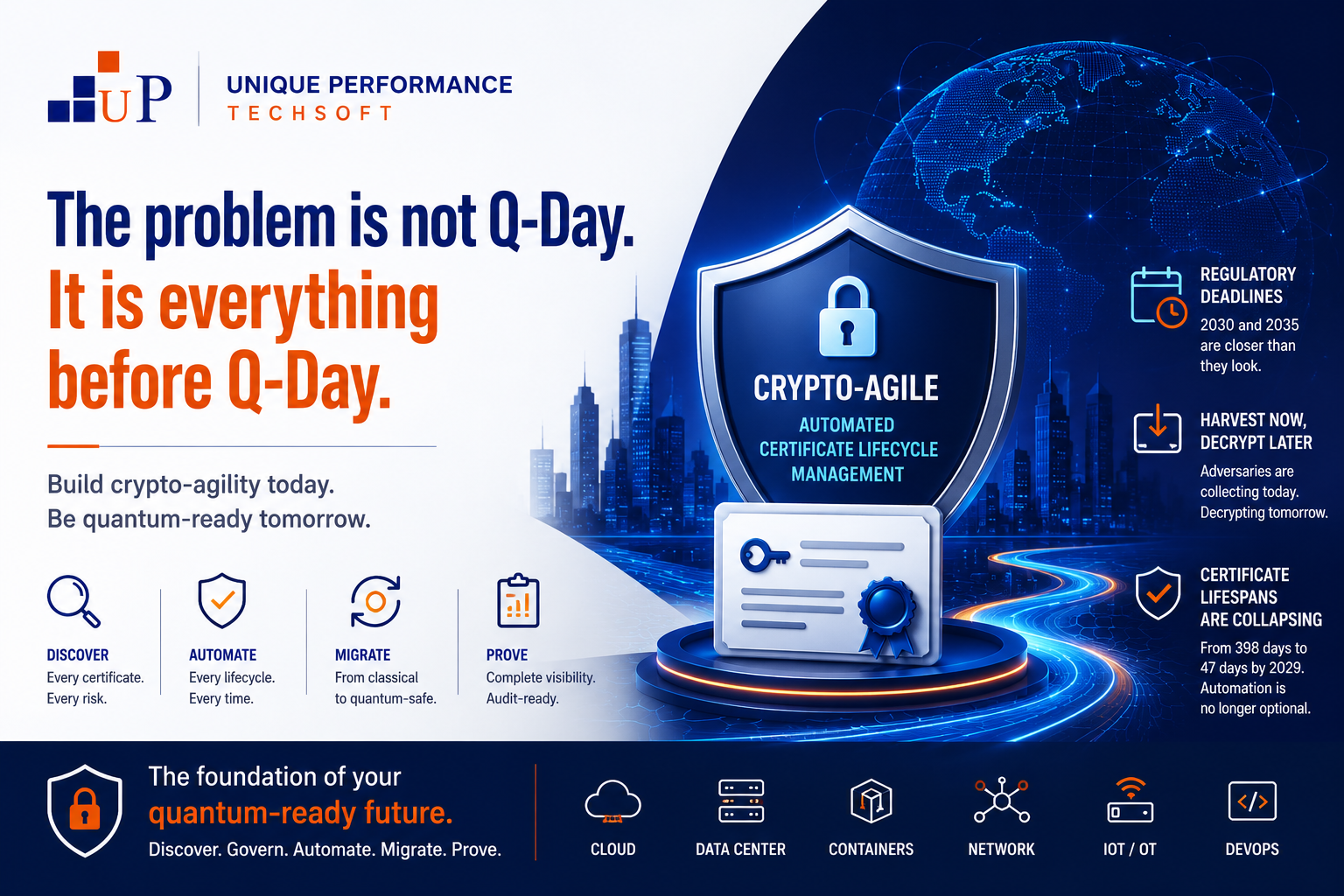
    A quantum-safe certificate methodology is not a product you install. It is an operating model with four properties:

    Complete cryptographic visibility. You know every certificate, key, algorithm, and issuing CA across your estate — cloud, on-prem, containers, load balancers, IoT, code signing, SSH. You cannot migrate what you cannot see, and in our experience, most enterprises discover 20–40% more certificates than they believed they had once discovery tooling is switched on.

    Policy-driven algorithm governance. Cryptographic choices (key type, key size, signature algorithm, validity period, approved CAs) are enforced centrally as policy, not left to individual application teams. When the organization decides to move a class of workloads from RSA-2048 to ML-DSA or to a hybrid certificate, that decision propagates through policy — not through a thousand Jira tickets.

    Automated issuance, renewal, and revocation at machine speed. Every certificate can be replaced without human hands touching a keystore. This is the mechanical foundation of crypto-agility: swapping an algorithm across the estate becomes a controlled re-issuance campaign rather than a multi-year emergency project.

    Staged migration with hybrid support. The transition runs through a hybrid phase — certificates and TLS handshakes that combine a classical algorithm with a PQC algorithm, so the connection remains secure if either component holds. Hybrid is the bridge, not the destination; the methodology must anticipate the eventual retirement of the classical component entirely.

    How CyberArk CLM operationalizes each phase

    Phase 1 — Discover and inventory (your Cryptographic Bill of Materials)

    CyberArk Certificate Manager continuously scans networks, cloud accounts, Kubernetes clusters, and application platforms to build a live inventory of every machine identity: which algorithm signed it, key length, expiry, issuing CA, where it is installed, and who owns it. This becomes your Cryptographic Bill of Materials (CBOM) — the single most important artifact in any PQC program, and the first item every quantum-readiness framework (NIST, DHS, BSI) tells you to produce. The inventory also exposes quantum-vulnerable outliers immediately: long-lived RSA-1024 stragglers, self-signed certificates on internal services, shadow certificates issued outside sanctioned CAs.

    Phase 2 — Prioritize by risk, not by convenience

    With the inventory in place, classify certificates by data sensitivity and confidentiality lifespan. A TLS certificate protecting a payments API that carries data regulated under RBI cybersecurity directions deserves earlier PQC treatment than an internal dashboard. CLM’s tagging, ownership mapping, and reporting let you segment the estate into migration waves and defend that prioritization in front of auditors and the board.

    Phase 3 — Enforce crypto policy centrally

    Define policies in Certificate Manager that specify approved algorithms, minimum key strengths, maximum validity periods, and permitted CAs per business unit or environment. As PQC-capable CAs (DigiCert, Entrust, and others now issue hybrid and ML-DSA certificates) come into your trust program, you introduce them through the same policy layer. Non-compliant certificate requests are blocked at issuance rather than discovered at audit.

    Phase 4 — Automate renewal and rehearse the algorithm swap

    This is where CLM converts strategy into muscle memory. Because the platform already automates issuance, installation, renewal, and revocation across web servers, load balancers, cloud services, and container platforms, an algorithm migration becomes a re-issuance campaign you can rehearse. Run a controlled pilot: re-issue a wave of internal certificates under a hybrid profile, validate handshake behavior and certificate chain sizes (ML-DSA signatures are substantially larger than ECDSA, which can surface problems in constrained devices, CDNs, and middleboxes), then expand wave by wave. The shrinking public-TLS validity periods actually help here — every 200-day or 47-day renewal cycle is a natural, low-risk inflection point at which to upgrade the cryptography.

    Phase 5 — Retire classical algorithms and prove it

    The endgame is the controlled deprecation of RSA and ECC in line with the 2030/2035 horizon. CLM’s audit trails, compliance dashboards, and revocation automation let you demonstrate — to regulators, customers, and cyber-insurers — exactly which portion of the estate is PQC-ready, which is hybrid, and which is still classical with a documented remediation date. Quantum readiness stops being a slide in a strategy deck and becomes a measurable KPI.

    Why this matters especially for Indian BFSI and regulated enterprises

    Banks, insurers, and financial intermediaries in India operate under RBI, SEBI, and IRDAI frameworks that emphasize cryptographic controls, key management, and demonstrable governance. These regulators historically align with NIST direction, so the 2030 deprecation horizon should be read as a planning anchor, not someone else’s problem. More importantly, the data these institutions protect — KYC records, transaction histories, policy documents — carries confidentiality obligations measured in decades, which makes HNDL a present-tense risk, not a future one. A CLM-anchored quantum-safe methodology gives compliance teams the inventory, policy enforcement, and audit evidence they will inevitably be asked to produce.

    A realistic 90-day starting plan

    You do not need a quantum computer, new hardware, or a finished PQC strategy to begin. In the first month, deploy discovery and build the CBOM — full certificate and key inventory with ownership mapping. In the second, classify the estate by data longevity and business criticality, and define your target crypto policies including hybrid profiles. In the third, automate renewals for your highest-risk certificate group and run a hybrid-certificate pilot in a non-production environment to surface compatibility issues early. Ninety days in, you will have converted an abstract quantum threat into a governed program with owners, waves, and evidence.

    The bottom line

    Quantum-safe migration is fundamentally a machine identity management problem at scale. The organizations that struggle will be the ones attempting algorithm swaps across an unmapped, manually managed certificate estate. The organizations that succeed will be the ones that built automated certificate lifecycle management first — because for them, moving to ML-KEM and ML-DSA is just another policy change flowing through an engine that already knows every certificate, owns every renewal, and can prove every step.

    CyberArk Certificate Manager provides that engine. The methodology above provides the roadmap. The only ingredient you supply is the decision to start before the deadlines — regulatory or quantum — start dictating the pace for you.


    Unique Performance Techsoft (UPT) helps enterprises design and implement certificate lifecycle management and machine identity security programs on the CyberArk platform, including PQC-readiness assessments, CBOM discovery engagements, and phased quantum-safe migration roadmaps. Reach out to our team to schedule a certificate estate assessment.
  • Your Newest Privileged Employee Is an AI Agent — And It Has No Manager

    Your Newest Privileged Employee Is an AI Agent — And It Has No Manager

    Securing agentic AI identities in Indian BFSI: why autonomy doesn’t transfer accountability

    By Unique Performance Techsoft | Identity Security Insights

    Somewhere in your organization right now, an AI agent may be reviewing a credit application, triaging a fraud alert, or provisioning a cloud resource. It authenticates to your systems, holds credentials, calls APIs, and takes actions — just like an employee with privileged access.

    Except no one interviewed it. No manager reviews its access quarterly. And when it’s decommissioned, there may be no offboarding process to revoke what it could touch.

    This is the defining identity security question of 2026: where are your AI agents, what can they access, and what can they do?

    AI agents are a new class of privileged identity

    For years, identity security has dealt with two populations: humans (employees, contractors, administrators) and machines (service accounts, API keys, certificates, workloads). AI agents are something new — they combine the reasoning and autonomy of a human user with the scale and velocity of a machine identity. That means they inherit the risks of both:

    • Human-identity risks: excessive privileges, credential compromise, session hijacking, social engineering (in the form of prompt injection)
    • Machine-identity risks: hardcoded secrets, stolen API keys, unmanaged lifecycle, no clear owner

    The scale problem is already here. CyberArk’s 2025 Identity Security Landscape found that machine identities outnumber human identities by more than 80 to 1 — and that while 42% of machine identities hold privileged or sensitive access, 88% of organizations still define “privileged user” as human-only. AI agents will accelerate this gap dramatically.

    The adoption curve in financial services is steep. CyberArk’s research on securing agentic AI found that nearly 40% of financial institutions already have agentic AI in production, yet fewer than 10% of organizations have adequate security controls for it. In India specifically, a 2025 Nasscom report noted that over 64% of BFSI leaders have already piloted agentic AI for underwriting, fraud detection, and customer service.

    Gartner has put a number on where this leads: it predicts that by 2028, 25% of enterprise breaches will be traced back to AI agent abuse.

    Where the risk actually lives

    The threats to agentic AI systems are not hypothetical. They map to well-understood identity attack patterns — amplified by autonomy:

    1. Over-privileged agents. Teams under delivery pressure grant agents broad, standing access “to make it work.” An agent that can read a loan book, write to a CRM, and send emails is a lateral-movement engine if compromised.

    2. Secrets sprawl. Agents authenticate to tools and data using API keys, tokens, and certificates. These often end up hardcoded in agent configurations, prompt files, or CI/CD pipelines. GitGuardian’s State of Secrets Sprawl 2026 report found 28.65 million new hardcoded secrets were added to public GitHub commits in 2025 alone — a 34% year-over-year increase.

    3. Prompt injection and tool poisoning. Because agents act on natural-language input, a malicious document or email can become an instruction. The EchoLeak vulnerability (CVE-2025-32711) against Microsoft 365 Copilot demonstrated zero-click data exfiltration through exactly this vector.

    4. Insecure agent-to-tool plumbing. The Model Context Protocol (MCP), now the de facto standard for connecting agents to enterprise tools, was designed for interoperability first. Gartner analysts have cautioned that MCP’s flexibility means security mistakes can manifest without continuous oversight, and Gartner projects that 25% of enterprise GenAI applications will experience at least five minor security incidents per year by 2028.

    5. Orphaned and shadow agents. Agents spun up for a pilot, forgotten, and left running with live credentials — the AI-era equivalent of the unmonitored service account that has featured in so many breach post-mortems.

    What Indian regulators require

    For Indian BFSI, this is no longer just a security conversation — it is a regulatory one. The message from every regulator is consistent: autonomy does not transfer accountability.

    RBI — FREE-AI Report (August 2025). The RBI’s committee report on Responsible and Ethical Enablement of AI sets out seven guiding “Sutras,” including Accountability — stating that regulated entities should be accountable for the decisions of their AI systems regardless of the level of autonomy of those systems. It calls for board-approved AI policies, AI system inventories, model risk management, and controls for AI-specific threats such as data poisoning and adversarial attacks. While advisory today, it signals clear supervisory direction.

    SEBI — AI Cybersecurity Advisory (May 2026). SEBI’s advisory to regulated entities mandates least-privilege access and Zero Trust Network Architecture for AI systems, and asks entities to prepare long-term plans covering autonomous and agentic mitigation. This builds on the SEBI (Intermediaries) Amendment Regulations, 2025, which hold regulated persons solely responsible for the outputs of AI tools — whether developed in-house or procured from vendors. SEBI CSCRF already requires monitoring of privileged access, API security controls, and SOC efficacy for existing entities.

    IRDAI. Guidelines for insurers extend access-control, encryption, and anomaly-detection requirements to AI models used in underwriting and fraud detection.

    The practical implication: if an AI agent in your environment misuses access, exfiltrates data, or executes an erroneous transaction, the regulatory liability sits with you — not with the AI vendor, and certainly not with the agent.

    Securing agents like the privileged identities they are

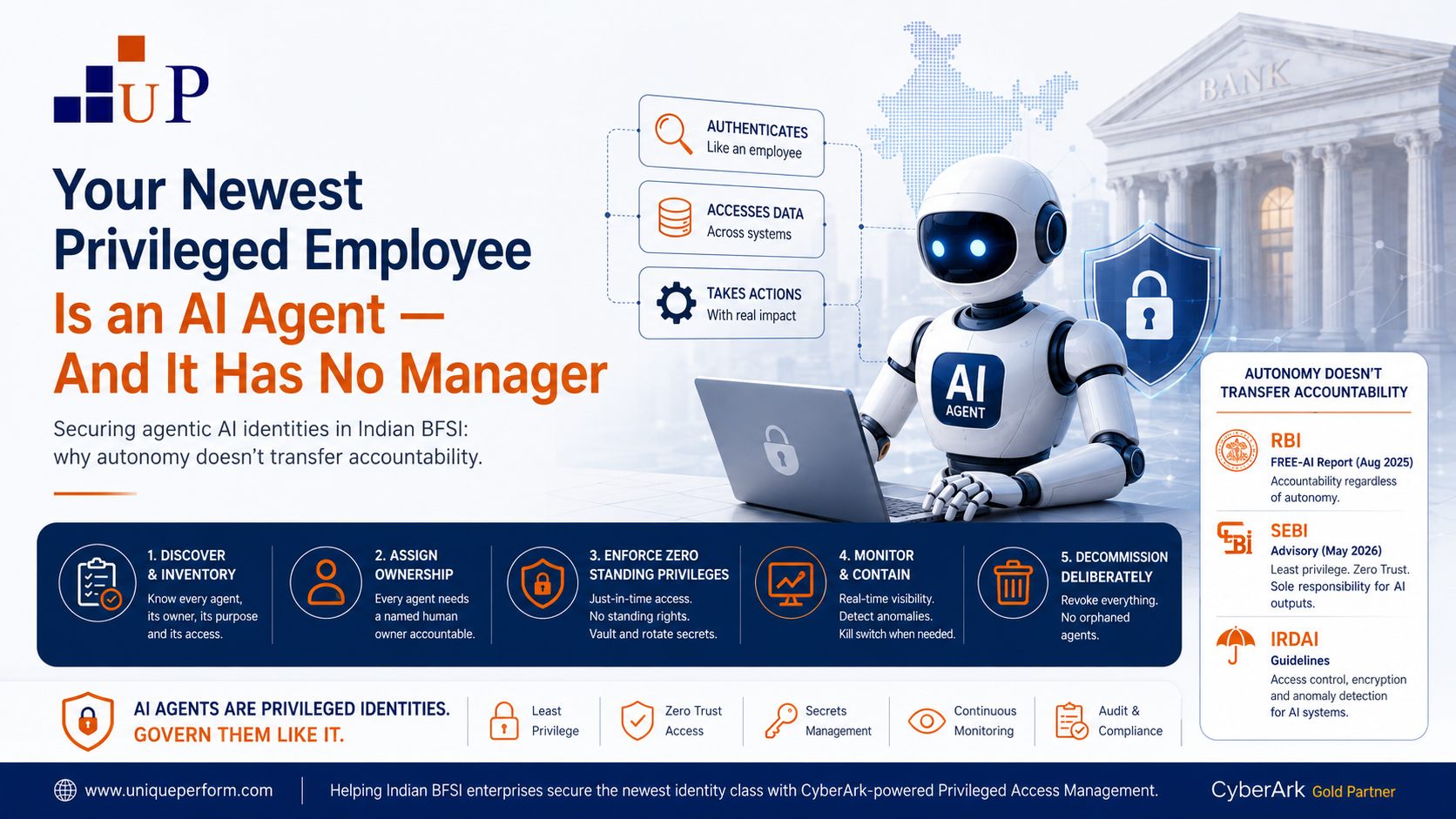
    The good news: the discipline for this problem already exists. It is Privileged Access Management — extended to a new identity class. A defensible agentic AI identity program covers five stages:

    1. Discover and inventory. You cannot secure agents you don’t know exist. Build and maintain a live inventory of every AI agent, its owner, its purpose, and its entitlements — including pilots and shadow deployments. (This also directly satisfies RBI FREE-AI’s AI-inventory expectation.)

    2. Assign ownership. Every agent needs a named human owner accountable for its access, behavior, and lifecycle — exactly as regulators expect.

    3. Enforce zero standing privileges. Agents should hold no permanent entitlements. Access should be granted just-in-time, scoped to the specific task, and expire automatically. Secrets and credentials used by agents should be vaulted, rotated, and never hardcoded.

    4. Monitor and contain. Agent sessions should be observable and auditable in real time, with the ability to detect anomalous behavior — an agent suddenly querying data outside its mandate — and a kill switch to terminate a rogue agent’s access instantly. Enforcement points such as CyberArk’s AI Agent Gateway sit between agents and the tools they call (including over MCP), applying privilege controls at the moment of action.

    5. Decommission deliberately. When an agent is retired, its credentials, tokens, and entitlements must be revoked as part of a formal offboarding process — preventing the orphaned-agent problem before it starts.

    Vendor ecosystems are converging on this model. CyberArk launched its Secure AI Agents Solution to apply identity security controls across the agent lifecycle; Microsoft’s Entra Agent ID brings agents under conditional access and identity protection; Okta has proposed protocols for cross-application agent access. The direction of the industry is unambiguous: AI agents are privileged identities, and they must be governed as such.

    Where to start

    Most BFSI organizations we speak with are somewhere between “we have pilots running” and “we don’t actually know how many agents we have.” Both are normal — and both are fixable. A practical first step is an agentic AI readiness assessment:

    • Discover every AI agent and AI-integrated workflow in your environment
    • Map each agent’s credentials, entitlements, and data access against least-privilege
    • Identify hardcoded secrets and unmanaged tokens in agent configurations
    • Benchmark your controls against RBI FREE-AI, SEBI CSCRF, and IRDAI expectations
    • Produce a prioritized roadmap to bring agents under privileged access governance

    As a CyberArk Gold Partner with deep implementation and managed-services experience in Indian BFSI — spanning PAM, machine identity, and secrets management — Unique Performance Techsoft helps regulated enterprises extend the identity security controls they already trust to the newest identity class in their environment.

    Your AI agents are already working. The question is whether they’re governed.

    Talk to our identity security team about an agentic AI readiness assessment.