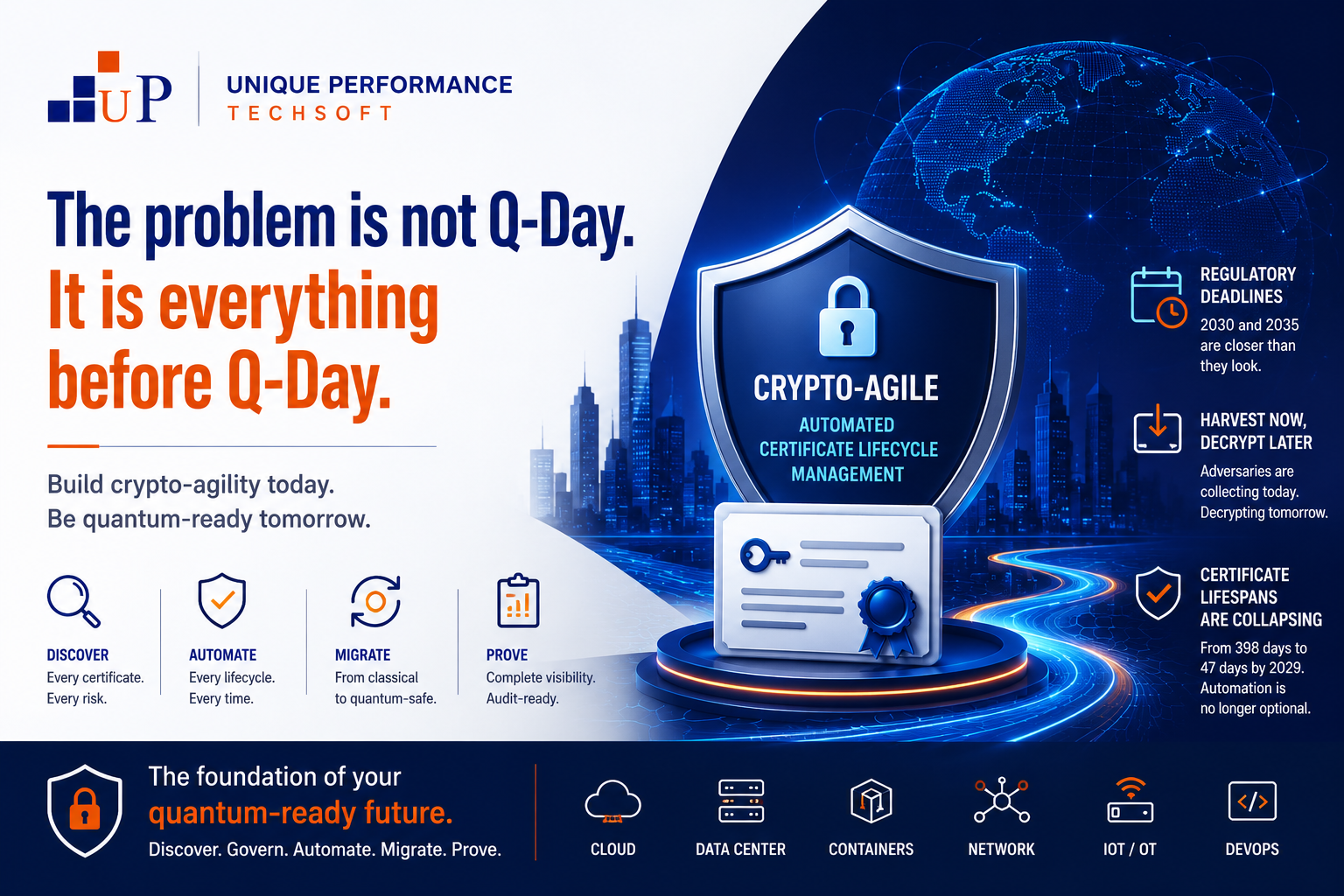
A quantum-safe certificate methodology is not a product you install. It is an operating model with four properties:
Complete cryptographic visibility. You know every certificate, key, algorithm, and issuing CA across your estate — cloud, on-prem, containers, load balancers, IoT, code signing, SSH. You cannot migrate what you cannot see, and in our experience, most enterprises discover 20–40% more certificates than they believed they had once discovery tooling is switched on.
Policy-driven algorithm governance. Cryptographic choices (key type, key size, signature algorithm, validity period, approved CAs) are enforced centrally as policy, not left to individual application teams. When the organization decides to move a class of workloads from RSA-2048 to ML-DSA or to a hybrid certificate, that decision propagates through policy — not through a thousand Jira tickets.
Automated issuance, renewal, and revocation at machine speed. Every certificate can be replaced without human hands touching a keystore. This is the mechanical foundation of crypto-agility: swapping an algorithm across the estate becomes a controlled re-issuance campaign rather than a multi-year emergency project.
Staged migration with hybrid support. The transition runs through a hybrid phase — certificates and TLS handshakes that combine a classical algorithm with a PQC algorithm, so the connection remains secure if either component holds. Hybrid is the bridge, not the destination; the methodology must anticipate the eventual retirement of the classical component entirely.
How CyberArk CLM operationalizes each phase
Phase 1 — Discover and inventory (your Cryptographic Bill of Materials)
CyberArk Certificate Manager continuously scans networks, cloud accounts, Kubernetes clusters, and application platforms to build a live inventory of every machine identity: which algorithm signed it, key length, expiry, issuing CA, where it is installed, and who owns it. This becomes your Cryptographic Bill of Materials (CBOM) — the single most important artifact in any PQC program, and the first item every quantum-readiness framework (NIST, DHS, BSI) tells you to produce. The inventory also exposes quantum-vulnerable outliers immediately: long-lived RSA-1024 stragglers, self-signed certificates on internal services, shadow certificates issued outside sanctioned CAs.
Phase 2 — Prioritize by risk, not by convenience
With the inventory in place, classify certificates by data sensitivity and confidentiality lifespan. A TLS certificate protecting a payments API that carries data regulated under RBI cybersecurity directions deserves earlier PQC treatment than an internal dashboard. CLM’s tagging, ownership mapping, and reporting let you segment the estate into migration waves and defend that prioritization in front of auditors and the board.
Phase 3 — Enforce crypto policy centrally
Define policies in Certificate Manager that specify approved algorithms, minimum key strengths, maximum validity periods, and permitted CAs per business unit or environment. As PQC-capable CAs (DigiCert, Entrust, and others now issue hybrid and ML-DSA certificates) come into your trust program, you introduce them through the same policy layer. Non-compliant certificate requests are blocked at issuance rather than discovered at audit.
Phase 4 — Automate renewal and rehearse the algorithm swap
This is where CLM converts strategy into muscle memory. Because the platform already automates issuance, installation, renewal, and revocation across web servers, load balancers, cloud services, and container platforms, an algorithm migration becomes a re-issuance campaign you can rehearse. Run a controlled pilot: re-issue a wave of internal certificates under a hybrid profile, validate handshake behavior and certificate chain sizes (ML-DSA signatures are substantially larger than ECDSA, which can surface problems in constrained devices, CDNs, and middleboxes), then expand wave by wave. The shrinking public-TLS validity periods actually help here — every 200-day or 47-day renewal cycle is a natural, low-risk inflection point at which to upgrade the cryptography.
Phase 5 — Retire classical algorithms and prove it
The endgame is the controlled deprecation of RSA and ECC in line with the 2030/2035 horizon. CLM’s audit trails, compliance dashboards, and revocation automation let you demonstrate — to regulators, customers, and cyber-insurers — exactly which portion of the estate is PQC-ready, which is hybrid, and which is still classical with a documented remediation date. Quantum readiness stops being a slide in a strategy deck and becomes a measurable KPI.
Why this matters especially for Indian BFSI and regulated enterprises
Banks, insurers, and financial intermediaries in India operate under RBI, SEBI, and IRDAI frameworks that emphasize cryptographic controls, key management, and demonstrable governance. These regulators historically align with NIST direction, so the 2030 deprecation horizon should be read as a planning anchor, not someone else’s problem. More importantly, the data these institutions protect — KYC records, transaction histories, policy documents — carries confidentiality obligations measured in decades, which makes HNDL a present-tense risk, not a future one. A CLM-anchored quantum-safe methodology gives compliance teams the inventory, policy enforcement, and audit evidence they will inevitably be asked to produce.
A realistic 90-day starting plan
You do not need a quantum computer, new hardware, or a finished PQC strategy to begin. In the first month, deploy discovery and build the CBOM — full certificate and key inventory with ownership mapping. In the second, classify the estate by data longevity and business criticality, and define your target crypto policies including hybrid profiles. In the third, automate renewals for your highest-risk certificate group and run a hybrid-certificate pilot in a non-production environment to surface compatibility issues early. Ninety days in, you will have converted an abstract quantum threat into a governed program with owners, waves, and evidence.
The bottom line
Quantum-safe migration is fundamentally a machine identity management problem at scale. The organizations that struggle will be the ones attempting algorithm swaps across an unmapped, manually managed certificate estate. The organizations that succeed will be the ones that built automated certificate lifecycle management first — because for them, moving to ML-KEM and ML-DSA is just another policy change flowing through an engine that already knows every certificate, owns every renewal, and can prove every step.
CyberArk Certificate Manager provides that engine. The methodology above provides the roadmap. The only ingredient you supply is the decision to start before the deadlines — regulatory or quantum — start dictating the pace for you.
Unique Performance Techsoft (UPT) helps enterprises design and implement certificate lifecycle management and machine identity security programs on the CyberArk platform, including PQC-readiness assessments, CBOM discovery engagements, and phased quantum-safe migration roadmaps. Reach out to our team to schedule a certificate estate assessment.